Konsultacje projektu European Model Clauses for Supply Chain

Konsultacje projektu European Model Clauses for Supply Chain

Z przyjemnością informujemy o rozpoczęciu trwających do 15 stycznia 2024 r. konsultacji projektu European Model Clauses (#EMC) / Europejskich Modelowych Klauzul mających wesprzeć m.in. odpowiedzialne praktyki zakupowe w łańcuchach dostaw.
EMC mają na celu dostosowanie umów między kupującymi i ich dostawcami do zasad należytej staranności w zakresie praw człowieka i środowiska (#HRDD#HREDD#CSDD), poprzez odpowiednie klauzule zapewniające bardziej efektywne poszanowanie praw człowieka i standardów środowiskowych w globalnych łańcuchach dostaw. Zawierają zapisy dot. zobowiązań nie tylko dostawców ale i kupujących, których dojrzałość i sposób prowadzenia działalności po swojej stronie także ma wpływ na to czy prawa człowieka szerzej w ich łańcuchu wartości są szanowane. EMC wspierają prowadzenie przez przedsiębiorstwa działalności gospodarczej w sposób zgodny w wymaganiami Wytycznych ONZ dot. biznesu i praw człowieka a także uwzględniający wymagania zawarte w projekcie dyrektywy #CSDDD.
Wszelkie uwagi i sugestie pomagające ulepszyć tekst klauzul będą mile widziane.  

Tekst jest dostępny TUTAJ (https://www.eur.nl/en/esl/media/2023-10-european-model-clauses-supply-chains)
Konsultacje i opinie TUTAJ (https://www.eur.nl/en/esl/events/consultation-european-model-clauses-supply-chains-project-2023-10-23 )

W poniższym nagraniu wyjaśniamy, dlaczego EMCs powstały, jaka jest ich struktura i jakie dotychczasowe problemy w relacji kupujący-dostawca starają się zaadresować.


Podziękowania za przygotowanie tego kompleksowego dokumenty nalezą się wszystkim osobom zaangażowanym w prace nieformalnej Europejskiej Grupie Roboczej ds. Klauzul Modelowych, a w szczególności dla jej inicjatora i przewodniczącego, prof. Martijna Scheltema, prof. Davida Snyder’a, a także członków i członkiń grupy roboczej z Francji, Niemiec, Włoch, Holandii, Hiszpanii, Portugalii, Polski i Wielkiej Brytanii, m.in. Daniel Schönfelder, Claire Bright, Angelica Bonfanti, Bettina Braun, Sarah Dadush, Michaela Streibelt, Stéphane Brabant, Lhuilier Gilles, Salli Swartz i wiele innych osób. Warto dodać, że te trwające niemal 2 lata prace obejmowały także etap analizy regulacji w wielu krajach członkowskich UE, m.in. po to by zidentyfikować, czy są obszary i zapisy, które w którymś z krajów mogą spotkać się z większymi wyzwaniami na etapie ich stosowania.
W pracach grupy roboczej udział wzięli związani i współpracujący z naszym instytutem eksperci tj. adw. Stanisław Drozd i Beata Faracik.

[oryginalny wpis: 20.10.2023; aktualizacja 22.12.2023]

Zapraszamy na pokaz filmu dokumentalnego „Discount workers”, 8 grudnia 2023 r., Kino „Atlantic”

Zapraszamy na pokaz filmu dokumentalnego „Discount workers”, 8 grudnia 2023 r., Kino „Atlantic”

Polish Institute for Human Rights and Business has the pleasure to invite you to a screening of a documentary: „Discount Workers”, followed by a discussion with its director: Christopher Patz.
???? Please join us on Fri, Dec 8th, at 18:00, Kino ATLANTIC and book your FREE seat here: https://tinyurl.com/ya8h7hf4
???? The screening is a WATCH DOCS FESTIVAL 2023 accompanying event.
???? The event is FREE OF CHARGE and it will be held in ENGLISH.
???? Please, secure your seat by registering at: https://forms.gle/hb4WMUXTKHSS5diAA
You can see trailer – here 🙂
This is the story of a struggle for justice, which reveals how change is coming from those at the end of the value chain.
In September 2012 a fire broke out in a textile factory in Karachi, Pakistan. Due to the complete lack of fire safety measures, around 260 workers perished in the flames.
The workers were producing jeans for the German retailer KiK! (Customer is King!) and just two weeks before the fire, the factory had been certified as safe by the Italian auditing company, RINA Services.
Saeeda is a widow who lost her only son in the disaster. She leads the families and victims to bring the first ever transnational human rights case by overseas victims against a German company before German courts.
—- —- —-
Od kilku dni w Warszawie trwa już 23. Międzynarodowy Festiwal Filmowy WATCH DOCS. A my chcemy zaprosić Was na wydarzenie towarzyszące: pokaz filmu „Discounted workers”.
We wrześniu 2012 r. w fabryce tekstyliów w Karaczi w Pakistanie wybuchł pożar. Z powodu braku odpowiednich zabezpieczeń w płomieniach zginęło 260 osób, które szyły dżinsy dla niemieckiego sprzedawcy KiK. Znamienne, że zaledwie dwa tygodnie przed pożarem włoska firma audytorska RINA Services przyznała fabryce certyfikat bezpieczeństwa. Film opowiada o Saeedzie, która w katastrofie straciła jedynego syna i walczy o sprawiedliwość.
Gościem specjalnym pokazu będzie reżyser filmu Christopher Patz, z którym porozmawiamy po zakończeniu seansu. Wydarzenie odbędzie się w kinie Atlantic w Warszawie w piątek 8 grudnia br. o godz. 18.00.  Zachęcamy do udziału!
Kilka ważnych informacji:
✅Pokaz filmu i rozmowa będą w j. angielskim.
✅Wydarzenie jest bezpłatne, ale obowiązują zapisy.
✅Wydarzenie na FB i więcej informacji: https://fb.me/e/1dtusF4dN
12. Forum ONZ dot. biznesu i praw człowieka – PIHRB współorganizatorem sesji poświęconej EŚW i Azji Centralnej

12. Forum ONZ dot. biznesu i praw człowieka – PIHRB współorganizatorem sesji poświęconej EŚW i Azji Centralnej

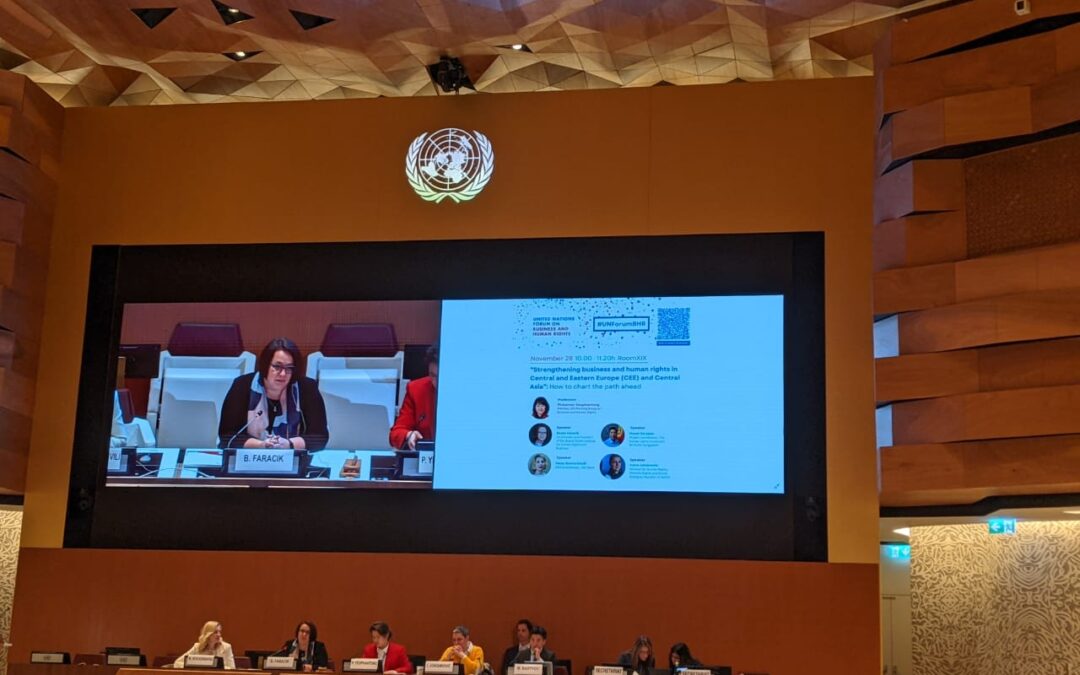
Z przyjemnością informujemy, że już po raz piąty PIHRB współorganizował sesję poświęconą wdrażaniu Wytycznych ONZ dot. biznesu i praw człowieka w Europie Środkowo-Wschodniej i Azji Centralnej. Prezeska PIHRB była także jedną z prelegentek, zabierających głos w tegorocznej sesji. Wydarzenie było organizowane przez Grupę Roboczą ONZ ds. biznesu i praw człowieka we współpracy z Polskim Instytutem Praw Człowieka i Biznesu, Uniwersytetem Prawa im. J. Mądrego w Charkowie oraz UNDP.

Nagranie z sesji jest dostępne tutaj.

Wszystkie informacje dot. sesji są dostępne na stronie ONZ oraz poniżej.

Strengthening Business and Human Rights in Central and Eastern Europe (CEE) and Central Asia: How to Chart the Path Ahead

Session co-organized by the Working Group on Business and Human Rights, the Polish Institute for Human Rights and Business (PL), Y. Mudryi National Law University (UA), and the United Nations Development Programme (UNDP) 

Interpretation provided in  English and Russian.

Brief description of the session: 
Developments in business and human rights in Central Asia, geostrategically positioned as a bridge that connects the vast Asian continent with Central and Eastern Europe, offer a valuable opportunity not only for mutual learning across Central and Eastern Europe and Central Asia regions but equally for cross-regional collaboration to tackle the pressing business-related human rights challenges faced in these two regions.

Especially in view of the recent mandatory human rights diligence developments in Europe, and specifically at the EU level, which stand to generate profound implications for States and businesses operating in Central and Eastern Europe, along with Central Asia, it is necessary for there to be an invigorated emphasis on collaborative efforts to promote and implement the UN Guiding Principles on Business and Human Rights (UNGPs). Indeed, multi-stakeholder dialogue is imperative to building a common understanding within both regions of the UNGPs. As highlighted in the UN Working Group’s recent report to the Human Rights Council on “Building Capacity for the Implementation of the United Nations Guiding Principles on Business and Human Rights”, the inclusive engagement with stakeholders — in particular, the meaningful participation of individuals and communities affected by business-related human rights abuse — is likewise central to strengthening the capacity of States, businesses, investors, academia and civil society, in order to expand the business and human rights community and achieve the critical policy and regulatory momentum for the realization of the UNGPs in these two regions.

The session brings together practitioners and experts of business and human rights to distill insights from current efforts by States, businesses, and civil society to promote and implement the UNGPs, including through multi-stakeholder initiatives and the development of guidance on the various aspects of responsible business conduct. Speakers will demonstrate the importance of putting rights holders and their voices at the center of efforts to translate the UNGPs into action as a necessary part of effective human rights due diligence legislation and processes.

Key objectives of the session:

  • Develop practical pathways for how the UNGPs as a policy and normative framework can be leveraged to bring States, businesses, and civil society together and generate sustainable and inclusive solutions to address business-related human rights challenges in Central and Eastern Europe as well as Central Asia;
  • Discuss the anticipated implications of the EU corporate sustainability due diligence directive on non-EU countries in the two regions, and what is expected from States and businesses in the region to ensure that legal developments in Western Europe result in positive outcomes for stakeholders in Central and Eastern Europe as well as Central Asia;
  • Highlight examples of emerging positive practices that have facilitated meaningful, inclusive, and effective multi-stakeholder engagement;
  • Identify the key drivers and challenges for advancing UNGPs implementation in the two regions.

Additional background documents: 

  • UN Working Group report on “Building Capacity for the Implementation of the United Nations Guiding Principles on Business and Human Rights”, available at A/HRC/53/24
  • UNDP (United Nations Development Programme) (2023). The Status of the Implementation of the UNGPs on Business and Human Rights in Europe and Central Asia. Istanbul: United Nations Development Programme. https://www.undp.org/eurasia/publications/implementation-un-guiding-principles-business-and-human-rights-ecis
  • Faracik, B., Uvarova, O. (red.) (2023). How (not) to Do Business and Human Rights in Central and Eastern Europe and Central Asia. Case Studies, PIHRB WPS 1/2023, Częstochowa: Polski Instytut Praw Człowieka i Biznesu. https://pihrb.org/wp-content/uploads/2023/06/PIHRB-WPS-1-2023-How-not-to-do-business-and-human-rights-in-CEE-CA.pdf

Moderators

avatar for Pichamon Yeophantong

Pichamon Yeophantong, Member, UN Working Group on Business and Human Rights

Ms. Pichamon Yeophantong is Associate Professor and Head of Research at the Centre for Future Defence and National Security, Deakin University. She also leads the Responsible Business Lab and the Environmental Justice and Human Rights Project, which are funded by an Australian Research… Read More →


Speakers

avatar for Ivana Joksimović

Ivana Joksimović, Minister for Human Rights, Minority Rights and Social Dialogue, Republic of Serbia

avatar for Beata Faracik

Beata Faracik, Co-Founder and President of the Board, Polish Institute for Human Rights and Business


avatar for Murat Karypov

Murat Karypov, Project coordinator, The human rights movement Bir Duino Kyrgyzstan Human rights defender, civic activist, lawyer, pro-feminist.


avatar for Maka Bochorishvili

Maka Bochorishvili, ESG Coordinator, TBC Bank

15 years experience in banking sector; since 2021, ESG Coordinator at TBC Bank – the largest financial institution in Georgia10+ years of experience in risk management, leading teams on capital and liquidity management, regulatory reporting, governance, information security
Jak wykorzystać Wytyczne OECD by osiągnąć zmianę. Warsztat dla NGOs z EŚW / Using the OECD Guidelines for change. Workshop for Central & Eastern Europe. 4 XII 2023 r.

Jak wykorzystać Wytyczne OECD by osiągnąć zmianę. Warsztat dla NGOs z EŚW / Using the OECD Guidelines for change. Workshop for Central & Eastern Europe. 4 XII 2023 r.

Wykorzystanie wytycznych OECD do zmian – Europa Środkowo-Wschodnia

Using the OECD Guidelines for change – Central and Eastern Europe

ROZPAKUJMY ZAKTUALIZOWANE WYTYCZNE OECD!

W czerwcu 2023 r. OECD opublikowała znacząco zaktualizowany tekst Wytycznych OECD dla przedsiębiorstw wielonarodowych dotyczące odpowiedzialnego prowadzenia działalności biznesowej.

Aby przybliżyć je organizacjom pozarządowym i szerzej, społeczeństwu obywatelskiemu w Europie Środkowo-Wschodniej, OECD Watch, której nasz instytut jest organizacją członkowską, organizuje w poniedziałek 4 grudnia br. o godz. 10.00 specjalne warsztaty, aby omówić, w jaki sposób zaktualizowane Wytyczne OECD mogą być pomocnym narzędziem dla społeczeństwa obywatelskiego i posiadaczy praw w naszym regionie – niezależnie od tego, czy chcą naprawienia szkody, pracy nad ustawodawstwem lub polityką lub współpracy ze społecznościami i innymi zainteresowanymi stronami.

Firmy z siedzibą w krajach stosujących się do Wytycznych, które prowadzą działalność w tych regionach, powinny przestrzegać standardów odpowiedzialnego postępowania w biznesie określonych w Wytycznych, a jeśli tak nie jest, społeczeństwo obywatelskie i oczywiście osoby poszkodowane, może starać się pociągnąć je do odpowiedzialności. Szczególnie że w regionie funkcjonuje wiele Krajowych Punktów Kontaktowych (KPK), do których można złożyć skargę na postępowanie przedsiębiorstw.

Podczas  sesji zostaną przedstawione Wytyczne i KPK oraz ich potencjalna wartość strategiczna dla kampanii społeczeństwa obywatelskiego w regionie. Swoim doświadczeniem podzielą się oprócz ekspertek OECD Watch, także przedstawiciele Bułgarskiego Centrum Biznesu i Praw Człowieka, Fundacji Frank Bold oraz Polskiego Instytutu Praw Człowieka (Beata Faracik). Będzie także przestrzeń na rozmowę i wysłuchanie głównych priorytetów organizacji i obaw związanych z odpowiedzialnością korporacyjną.

Podczas sesji zapewnione zostanie tłumaczenie symultaniczne z języka angielskiego na język bułgarski i język polski, a na życzenie (w zależności od zapotrzebowania) może być także zapewnione tłumaczenie na inne języki regionu.

Poniedziałek – 4 grudnia 2023 r. , 10:00 (Warszawa, CET) / 11:00 (EET) Zarejestruj się tutaj (ZOOM)


Let’s unpack the updated OECD Guidelines! In June the OECD released significantly updated text for the OECD Guidelines for Multinationals Enterprises on Responsible Business Conduct.

In June 2023, the OECD released significantly updated text as part of the OECD Guidelines for Multinational Enterprises on Responsible Business Conduct.

On Monday 4th December, OECD Watch will host a dedicated workshop for civil society in Central & Eastern Europe to discuss how the updated OECD Guidelines can be a helpful tool for civil society and rights holders in this region – whether you are seeking remedy for harm, working on legislation or policy, or engaging with communities and other stakeholders.

Companies based in Guidelines-following countries that are operating in these regions should follow the responsible business conduct standards in the Guidelines and, if they don’t, civil society may seek to hold them accountable. Additionally, a number of National Contact Points (NCPs) exist in this region.

This session will introduce the Guidelines and NCPs and their potential strategic value to civil society campaigns in the region and also give space to hear what your main priorities and concerns are related to corporate accountability.

Simultaneous interpretation from English to Bulgarian and Polish will be provided during the session, and other languages can be organised upon request (subject to demand).

Poniedziałek – 4 grudnia 2023 r. , 10:00 (Warszawa, CET) / 11:00 (EET) Register here (ZOOM)


Dzielimy się doświadczeniem podczas seminarium Rady Europy nt. handlu ludźmi do celów pracy przymusowej (13.06.2023)

Dzielimy się doświadczeniem podczas seminarium Rady Europy nt. handlu ludźmi do celów pracy przymusowej (13.06.2023)

O ile poprzednie lata były zdominowane przez prace nad narzędziami wspierającymi przedsiębiorstwa w identyfikacji i przeciwdziałaniu pracy przymusowej, teraz czas na dzielenie się doświadczeniem w tym zakresie, a także włączenie się w popularyzację Recommendation CM/Rec (2022)21 on preventing and combating trafficking in human beings for the purpose of labour exploitation, przyjętych przez Komitet Ministrów Rady Europy 27 września 2022 r. Okazją po temu będzie seminarium na ów temat organizowane w Warszawie już 13 czerwca br. Mamy nadzieję, że wydarzenie to zachęci polską administrację do podjęcia w końcu bardziej zdecydowanych kroków legislacyjnych, które ułatwią ściganie przestępstw tego rodzaju.

W seminarium reprezentować środowisko pozarządowe będzie prezeska PIHRB, Beata Faracik, która podzieli się doświadczeniem w sesji pt. „Corporate responsibility and corporate liability”.

Pliki do pobrania: