Common rules for the common market – the CSDDD is needed for businesses and human rights

Common rules for the common market – the CSDDD is needed for businesses and human rights

Common rules for the common market – the CSDDD is needed for businesses and human rights

Authors: Michaela Streibelt, Daniel Schönfelder, Claire Bright, Stéphane Brabant, Beata Faracik, Angelica Bonfanti, Carmen Marquez Carrasco, Martijn Scheltema, Lisa Szeponik, James Sinclair, Serra Cremer Iyi, Juho Saloranta, Theresa Gigov, Noah Neitzel, Cecilia Barral Diego and Céline Graça Pires.

[Niniejszy artykuł został pierwotnie opublikowany na Nova Centre on Business, Human Rights and the Environment Blog Uniwersytetu Nova w Lizbonie – link]


The Corporate Sustainability Due Diligence Directive (CSDDD) is on the Council’s agenda for this week, which might be one of the last chances for the urgently needed directive to be adopted before the EP elections. There still seems to be a lack of understanding regarding the substantive arguments raised by some in criticism of the directive. Upon closer investigation, these arguments are based on an inaccurate understanding of the law. As professionals working with companies on how to implement human rights in their activities and supply chains, the authors of this text address them from a practical standpoint.

It is also worth remembering from the outset that, in the seminal study on due diligence through the supply chain, the vast majority of stakeholders (including notably  businesses, civil society, academics and government officials) were in favour of the introduction of mandatory due diligence at the European level in order to identify, prevent and address the adverse human rights and environmental impacts that companies can have in their operations and throughout their global value chains. It was perceived as the regulatory option which would yield the greatest positive social, environmental, and human rights impacts. Interestingly, only some of the business associations (which are now the most vocal group against the directive) were not in favour of the adoption of a mandatory due diligence law at the European level, unlike all other stakeholder groups including companies themselves and their own member companies which saw the benefits of an EU legislation on mandatory due diligence. Indeed, nearly 70% of companies surveyed anticipated that mandatory human rights and environmental due diligence legislation would benefit business by providing legal certainty and leveling the playing field by holding all competitors in the EU to the same standards.

The study also highlighted the potential of such type of regulation in improving access to remedies for affected individuals and communities and improving the implementation of due diligence practices and processes by companies. The study, which gathered over 600 responses from key stakeholders throughout the European Union highlighted the limitations of soft law and voluntary approaches in regulating corporate behaviour in relation to adverse human rights and environmental impacts, since, just over one-third of business respondents indicated that their companies undertake human rights and environmental due diligence, and in the majority of cases, the due diligence exercise was limited to first-tier suppliers.

A bureaucracy monster, harmful to companies?

Some political parties and business associations have criticised the directive and alleged it would overly burden companies, especially SMEs. It has also been wrongly argued that the directive requires companies to guarantee that there are no potential or actual adverse impacts in their supply chain. That would indeed be impossible. However, a careful analysis of the directive shows that it does in fact not set forth such requirements. On the contrary, and in line with international standards in the field which impose an obligation of means and not an obligation of result, the directive simply requires companies to put in place due diligence processes which are appropriate to their size and influence, including the possibility to prioritize the most severe risks. In other words, the directive sets out a standard of conduct, what society expects from a reasonable company behaving in a responsible and sustainable way. Nothing more, nothing less. There is no expectation for companies to be perfect, they only have to show that they are doing their best efforts to avoid harming human rights in their activities and throughout their supply chains and remedy any such harm when they do occur. Also, and in line with international standards, it embeds the proportionality principle whereby companies that have more means (i.e. larger companies) are required to do more. Furthermore, the CSDDD contains provisions that specifically protect small and medium enterprises (SMEs): they have to be treated fairly and cannot be overburdened. In practice, SMEs are already facing increasing demands from their buyers in relation to human rights and the environment (regardless of the directive), but are not afforded any support for doing so. The directive seeks to change this and SMEs would benefit from these rules.

Level playing field and uniform standard instead of patchwork legislation

The CSDDD would create a common standard for the common market of the EU. Having one uniform standard in the whole EU benefits competition. In the study on due diligence through the supply chains, 70% of the companies surveyed affirmed that having one uniform standard at the EU level rather than a patchwork of different standards at the national levels would actually benefit business.

Currently, France, Germany and Norway have due diligence laws, the Netherlands adopted the Child Labour Due Diligence Act in 2019 (even though it is not yet into force), and legislative proposals in this field have emerged in many more countries. Other member states are likely to pass such laws should the CSDDD fail. The CSDDD is a chance to ensure efficiency and coherence.

The CSDDD ensures that European companies are not put at a competitive disadvantage compared to their non European counterparts by also requiring non-EU companies with a certain turnover in the EU or royalties from franchise or licensing agreements to put in place human rights and environmental due diligence processes. European companies who compete with companies from abroad would benefit from such a level playing field.

Withdrawal from difficult regions?

The CSDDD does not require European companies to withdraw from difficult at risk countries, regions, supply chains or suppliers. Instead, in line with international standards, the directive provides that termination should be used only as a matter of last resort and guarantee a responsible exit. The examples of France and Germany have shown that the fear that suppliers from countries of the Global South will refuse to provide to European companies is completely unfounded. In fact, many of these suppliers are already in the process of developing due diligence processes to respond to the existing requirements of their buyers who are exercising due diligence throughout their supply chains to respond to consumers and investors pressure. Due diligence will not offset the competitive advantage of lower production costs and many resources simply are not available in the EU (coffee, cocoa, cobalt to just name a few).

Clear rules on civil liability create legal security

Among the most misleading claims in relation to the CSDDD is that companies will face unmanageable and unreasonable liability risks. In fact, it is quite the opposite since exercising appropriate human rights and environmental due diligence is actually the best way for companies to protect themselves from liability. As a result, by setting out requirements and clear expectations for companies in relation to due diligence, the CSDDD helps them address the liability risk.

In fact, however, the liability rule of the CSDDD is beneficial to companies since it would create a clear, balanced, uniform, and – most importantly – almost universally applicable liability standard. Currently, companies already face liability risks as exemplified by the recent cases against Shell in the Netherlands, and La Poste in France, amongst many others.

They might be liable under different national laws because the law applicable to a tortious act is (at least in most cases) the law where the damage occurred. This means that European companies have to consider potential liability risks under many different domestic laws, which might require understanding liability norms of other countries in other languages and even getting legal advice in different countries. The CSDDD only holds companies liable for damages resulting from the intentions or negligent violation of the obligation to implement preventive or remedial measures.  If they conducted appropriate due diligence, they are exonerated, making liability manageable and foreseeable. This norm would be applicable as an overriding mandatory provision leading to the exclusion of other liability norms. Therefore, the CSDDD provides clear and fair rules on civil liability that create legal security for companies and victims.

Corporate sustainability with or without the CSDDD

Whether or not the CSDDD is adopted, companies are already and will increasingly be subjected to expectations and requirements to put in place due diligence processes to ensure that they do not harm human rights and the environment in their operations and throughout their supply chains. Indeed, international standards like the UN Guiding Principles on Business and Human Rights, the OECD Guidelines for Multinational Enterprises and related guidance, and the ILO Tripartite Declaration of Principles concerning multinational enterprises and social policy already exist and are being implemented by a growing number of companies. They are also influencing States to adopt laws in this respect. In addition, companies are increasingly subjected to the pressure from consumers and investors to behave responsibly and sustainably. Recent studies estimate that 160 millions children are in child labour (that is one child out of 10 on the global scale), a number which has been increasing in recent years, especially amongst children between 5 and 11 years old working in hazardous conditions. The ILO estimates that 18 million people are exploited as forced labour in the private sector. Other studies have consistently shown that companies can be involved in adverse human rights impacts covering the whole spectrum of internationally recognised human rights. Preventing and addressing such involvement through policies and practices is core to sustainable development as recognised by the UN Sustainable Development Goals which affirm that human rights are at the core of all 17 goals and 169 targets. At the end of the day, the CSDDD simply turns already existing international standards and societal expectations on corporate behaviour into hard law in order to ensure companies are on the right side of history.

Suggested Citation: M. Streibelt, D. Schönfelder, C. Bright and al., ‘Common rules for the common market – the CSDDD is needed for businesses and human rights’, Nova Centre on Business, Human Rights and the Environment Blog, 27th Feburary 2024, link: https://novabhre.novalaw.unl.pt/common-rules-for-the-common-market-the-csddd-is-needed-for-businesses-and-human-rights/

Open Letter – Lawyers and scholars working on EMC stress the importance of CSDDD

Open Letter – Lawyers and scholars working on EMC stress the importance of CSDDD


Lawyers and scholars working on EMC stress the importance of CSDDD


To the Governments of the Member States of the European Union, the Members of European Parliament and the Members of the national Parliaments of the Member States of the European Union

We are legal professionals from France, Germany, Italy, Spain, Poland, the Netherlands and Portugal who work together to develop European Model Clauses (EMC) in the framework of the future European Corporate Sustainability Due Diligence Directive (CSDDD). The EMC shall encourage balanced and effective contracts between buyers and suppliers worldwide.

We met in Warsaw last week – following meetings in Lisbon and Rotterdam in 2023. Warsaw is a city that has suffered many European conflicts, wars and human suffering. It is thus a symbolic place to reflect upon the crucial need for strong protection for human rights as a basis of our peaceful and prosperous existence together.

Coming from very different EU countries, backgrounds and philosophies, we are all driven by the need to respect the fundamental values of human rights. They are the bedrock of the European Union, enabling stability and peace in Europe.  We believe that the CSDDD – once enacted – will be a valuable tool for to enable companies to contribute to these values through Human and Environmental Due Diligence in their value chains. This is a historic opportunity for the EU.

The text of the CSDDD was negotiated in the trilogue, which is the legitimate procedure that we, as Europeans, use to negotiate directives to be respected by all of the EU Members. As members of a project that crosses many borders, realities and interests, we understand and accept that compromises are also a bedrock of Europe.

Kofi Annan said in Davos that markets should have a « human face », which led to John Ruggie developing UNGC and UNGPs. Tools and regulations such as the CSDDD are essential to anchor these principles in business practice. We therefore call on politicians in our respective countries to further strengthen our common principles: for the EU, for the planet and for humanity: Please vote in favor of the CSDDD!


Anna Beckers, Maastricht University (GER)

Angelica Bonfanti, University of Milan (IT)

Stéphane Brabant, Avocat at Paris Bar (FR)

Bettina Braun, LL.M. (Columbia) (GER)

Claire Bright, NOVA School of Law (PT)

Carmen Márquez Carrasco, Catedrática de Derecho Internacional Público y Relaciones Internacionales, Universidad de Sevilla (ES)

Avv. Achille Caliò Marincola, LL.M. (IT)

Beata Faracik, LL.M., Polish Institute for Human Rights and Business (PL)

Gilles Lhuilier, Ecole Normale supérieur de Rennes, Membre senior de l`lnstitut Universitaire de France (FR)

Avv. Randazzo Roberto (IT)

Daniel Schönfelder, Lawyer (GER)

Martijn Scheltema, Partner at Pels Rijcken\professor at Erasmus University (NL)

Michaela Streibelt, Lawyer (GER)

Salli Anne Swartz, American and French Lawyer EU Business + Human Rights (FR)


Download the letter in PDF

Call for input for the Working Group’s report on respecting the rights of LGBTI people in business context. Deadline: 1.03.2024

Call for input for the Working Group’s report on respecting the rights of LGBTI people in business context. Deadline: 1.03.2024

Żródło: OHCHR 

The UN WG on BHR calls for input  for its report on LGBTIQ+ people in business context to be presented to the 79th session of the General Assembly in October 2024

Background

In recent years, the business and human rights agenda has seen a real strengthening in support for greater equality and respect of the rights of lesbian, gay, bi, trans, and other gender diverse, and intersex (LGBTI) people. Alongside civil society actors and LGBTI movements, businesses and States have undertaken a number of actions and developed strategies and policies to tackle discrimination against LGBTI people. This includes taking action to address discriminatory laws, policies, attitudes and practices in the communities in which businesses operate, promoting inclusive working environments, as well as looking at business practices up and down the supply chain. At the same time, much more remains to be done to prevent and address human rights abuses from being perpetrated against LGBTI people and to ensure accountability when harm occurs in the context of business activities. The UNGPs make a key contribution to the implementation of human rights safeguards in the context of business activities. In order to effectively meet their respective human rights duties under the UNGPs, States need to adopt measures to effectively prevent and address violence and discrimination against LGBTI people, in line with their legal obligations under international human rights law. In line with their own responsibility to respect human rights, business enterprises are required to identify, prevent, mitigate and address any adverse impacts on people they may be involved with through their own activities, or as a result of their business relationships, including on people with different sexual orientations, gender identities or expressions, or sex characteristics. This means considering how they face negative impacts differently and disproportionately and addressing additional barriers in seeking access to justice and to an effective remedy because of intersecting and multiple forms of discrimination they experience. The diversity of contexts and of individuals making up the LGBTI spectrum confronts businesses with a wide range of potential human rights impacts requiring a nuanced and differentiated approach. This is particularly challenging in situations where discrimination based on different sexual orientation, gender identity or expression, or sex characteristics intersects with other forms of discrimination, such as age, race, ethnicity, disability, or socio-economic status. The UNGPs acknowledge the importance for States and businesses to adopt a gender perspective,  and the Working Group on Business and Human Rights (Working Group) developed guidance on gender in 2019 (A/HRC/41/43) to incorporate a gender lens to the implementation of the UNGPs, with a specific focus on women and girls. The Working Group proposed gender guidance specific to each of the 31 UNGPs. The guidance should be read together with other relevant standards, such as the standards of conduct for business, published by the Office of the United Nations High Commissioner for Human Rights, aimed at tackling discrimination against lesbian, gay, bisexual, transgender and intersex persons. Yet, many countries lack adequate institutional and regulatory frameworks that comprehensively and systematically incorporate the situation of LGBTI people, including in national action plans on business and human rights, mandatory human rights due diligence regulations, or in disclosure or transparency requirements for companies and investors.  In many parts of the world, the current corporate practice of human rights due diligence fails to identify, prevent, mitigate and account for adverse human rights impacts on LGBTI people in a systematic and appropriate manner, if at all.

Objectives

The Working Group seeks to provide further gender-related guidance to both States and businesses to adopt a LGBTI lens in implementing the UNGPs, with practical recommendations for what it means to protect, respect and remedy the rights of LGBTI persons in the context of business operations. It aims to contribute to a step forward in helping States and businesses translate their respective human rights obligations and responsibilities into practical action on the ground, and to seize an important opportunity to enlarge the role of business in tackling discriminatory practices in countries around the world.

Key questions

Next Steps

Input should be sent by e-mail. They must be received by 1 March 2024.Email address:
hrc-wg-business@un.org
Email subject line: GA 79th submission
Word limit:2500 words
File formats: Word, PDF
Accepted languages:
English, Spanish, French
Konferencja międzynarodowa „Od soft law do wiążących regulacji. Jak wdrażać i egzekwować CSDDD”, 26.1.2024

Konferencja międzynarodowa „Od soft law do wiążących regulacji. Jak wdrażać i egzekwować CSDDD”, 26.1.2024

W dniu 26 stycznia 2024 r., w godzinach popołudniowych, odbyła się w Warszawie międzynarodowa konferencja naukowa na temat „Od soft law do wiążących regulacji. Jak wdrażać i egzekwować CSDDD. Wnioski z funkcjonowania niemieckich i francuskich regulacji w sprawie należytej staranności dot. praw człowieka” (strona internetowa konferencji:  wersja polskawersja angielska), zorganizowana z inspiracji Polskiego Instytutu Praw Człowieka i Biznesu we współpracy z Wydziałem Prawa i Administracji Uniwersytetu Warszawskiego oraz Naczelną Radą Adwokacką i przy wsparciu partnerów wydarzenia – kancelarii Wardyński i Wspólnicy oraz Eversheds Sutherland Poland.  W wydarzeniu uczestniczyło ok. 80 osób osobiście i ponad 150 online.

Koniec stycznia 2024 r. był dobrym momentem by przybliżyć polskiej publiczności, w szczególności prawnikom, przedstawicielom administracji publicznej oraz politykom projekt dyrektywy dot. należytej staranności przedsiębiorstw w zakresie zrównoważonego rozwoju (CSDDD, CS3D). Zawarcie w połowie grudnia 2023 r. w ramach negocjacji treści projektu politycznego porozumienia w najbardziej kontrowersyjnych kwestiach, przybliżyło znacząco bowiem szanse na przyjęcie tej dyrektywy – kolejnej w pakiecie Zielonego Ładu – jeszcze w tej kadencji Parlamentu Europejskiego. O ile nie wydarzy się nic nieprzewidywalnego, finalny kształt dyrektywy poznamy już wiosną 2024 r.

W Polsce dotychczas szersza dyskusja nad tą dyrektywą nie miała miejsca. I to mimo, że idzie ona znacznie dalej niż – owiana legendą wymagającej – dyrektywa dot. sprawozdawczości przedsiębiorstw w zakresie zrównoważonego rozwoju (CSRD) wraz z ESRS’ami, a jej przyjęcie pociągnie za sobą zmiany w wielu ustawach w tym m.in. w KSH. Dyrektywa zawiera wiele przepisów, które w mniejszym lub większym stopniu będą przełomowe dla sposobu w jaki powinna być prowadzona działalność gospodarcza. Wyjątkiem na tym tle są prace Grupy Roboczej ds. należytej staranności funkcjonującej w ramach Zespołu ds. Zrównoważonego Rozwoju i Społecznej Odpowiedzialności Przedsiębiorstw działającego przy MFIPR, przy czym grono jej członków jest ograniczone. Jeśli chodzi o poziom UE, projekt Komisji Europejskiej poprzedzony był niezwykle szczegółową analizą zrealizowaną na zlecenie KE oraz szeregiem analiz zleconych przez Parlament Europejski (m.in. Krajewski & Faracik „Substantive Elements of Potential Legislation on Human Rights Due Diligence„, 2020),

Konferencja miała na celu zmienić ten stan rzeczy i rozpocząć publiczną dyskusję o projekcie Dyrektywy Parlamentu Europejskiego i Rady w sprawie należytej staranności przedsiębiorstw w zakresie zrównoważonego rozwoju (Dyrektywa CSDD; Corporate Sustainability Due Dilligence Directive, CSDDD lub CS3D).

W konferencji wzięli udział eksperci zagraniczni: prof. David Snyder, Profesor Prawa, Dyrektor Programu Prawa Gospodarczego, American University – Washington College of Law, prof. Martijn Scheltema, adwokat – partner, Pels Rijcken & Droogleever Fortuijn N.V., Stéphane Brabant, starszy partner, Paris Avocat à la Cour, Trinity International AARPI, Bettina Brown, German Institute for Human Rights, Daniel Schönfelder, LL.M. (Bogota), ale także – co niezwykle istotne – praktycy prawa oraz wysocy przedstawiciele polskiej administracji publicznej, w tym r.pr. Zuzanna Rudzińska-Bluszcz, Podsekretarz Stanu, Ministerstwo Sprawiedliwości, Monika Kusina-Pycińska, Dyrektor Departamentu Spraw Europejskich i Współpracy Międzynarodowej, Ministerstwo Funduszy i dr Wojciech Federczyk, Dyrektor Krajowej Szkoły Administracji Publicznej.

W pierwszej częśći wydarzenia przybliżono osobom uczestniczącym treść dyrektywy i projekty narzędzi opracowanych w celu wsparcia przedsiębiorstw w sprostaniu oczekiwaniom wynikającym z dyrektywy.  Następnie omówiono rozwiązania wspierające odpowiedzialne praktyki zakupowe, w szczególności wzorcowe klauzule umowne – tak w wersji ABA jak i zaawansowanym projekcie European model contract clauses for supply chain wychodzącym naprzeciw postanowieniom dyrektywy dot. planów opublikowania przez Komisję Europejską wzorcowych klauzul umownych. (Więcej o projekcie EMC tutaj).  

W drugiej części konferencji skupiono się na kwestiach związanych z egzekwowaniem przez administrację publiczną wdrażania przez firmy regulacji dot. obowiązkowej należytej staranności w zakresie praw człowieka, w szczególności w zakresie dotyczącym powołania tzw. Supervisory Authorities. Punktem wyjścia do dyskusji będą prezentacje praktyków prawa prezentujące wnioski z wdrażania krajowych regulacji dot. obowiązkowej należytej staranności w zakresie praw człowieka we Francji i Niemczech. 

PROGRAM

Program konferencji w wersji PDF pobierz TUTAJ.

Strona internetowa konferencji:  wersja polskawersja angielska

ZDJĘCIA Z KONFERENCJI 


Zapraszamy na pokaz filmu dokumentalnego „Discount workers”, 8 grudnia 2023 r., Kino „Atlantic”

Zapraszamy na pokaz filmu dokumentalnego „Discount workers”, 8 grudnia 2023 r., Kino „Atlantic”

Polish Institute for Human Rights and Business has the pleasure to invite you to a screening of a documentary: „Discount Workers”, followed by a discussion with its director: Christopher Patz.
???? Please join us on Fri, Dec 8th, at 18:00, Kino ATLANTIC and book your FREE seat here: https://tinyurl.com/ya8h7hf4
???? The screening is a WATCH DOCS FESTIVAL 2023 accompanying event.
???? The event is FREE OF CHARGE and it will be held in ENGLISH.
???? Please, secure your seat by registering at: https://forms.gle/hb4WMUXTKHSS5diAA
You can see trailer – here 🙂
This is the story of a struggle for justice, which reveals how change is coming from those at the end of the value chain.
In September 2012 a fire broke out in a textile factory in Karachi, Pakistan. Due to the complete lack of fire safety measures, around 260 workers perished in the flames.
The workers were producing jeans for the German retailer KiK! (Customer is King!) and just two weeks before the fire, the factory had been certified as safe by the Italian auditing company, RINA Services.
Saeeda is a widow who lost her only son in the disaster. She leads the families and victims to bring the first ever transnational human rights case by overseas victims against a German company before German courts.
—- —- —-
Od kilku dni w Warszawie trwa już 23. Międzynarodowy Festiwal Filmowy WATCH DOCS. A my chcemy zaprosić Was na wydarzenie towarzyszące: pokaz filmu „Discounted workers”.
We wrześniu 2012 r. w fabryce tekstyliów w Karaczi w Pakistanie wybuchł pożar. Z powodu braku odpowiednich zabezpieczeń w płomieniach zginęło 260 osób, które szyły dżinsy dla niemieckiego sprzedawcy KiK. Znamienne, że zaledwie dwa tygodnie przed pożarem włoska firma audytorska RINA Services przyznała fabryce certyfikat bezpieczeństwa. Film opowiada o Saeedzie, która w katastrofie straciła jedynego syna i walczy o sprawiedliwość.
Gościem specjalnym pokazu będzie reżyser filmu Christopher Patz, z którym porozmawiamy po zakończeniu seansu. Wydarzenie odbędzie się w kinie Atlantic w Warszawie w piątek 8 grudnia br. o godz. 18.00.  Zachęcamy do udziału!
Kilka ważnych informacji:
✅Pokaz filmu i rozmowa będą w j. angielskim.
✅Wydarzenie jest bezpłatne, ale obowiązują zapisy.
✅Wydarzenie na FB i więcej informacji: https://fb.me/e/1dtusF4dN
12. Forum ONZ dot. biznesu i praw człowieka – PIHRB współorganizatorem sesji poświęconej EŚW i Azji Centralnej

12. Forum ONZ dot. biznesu i praw człowieka – PIHRB współorganizatorem sesji poświęconej EŚW i Azji Centralnej

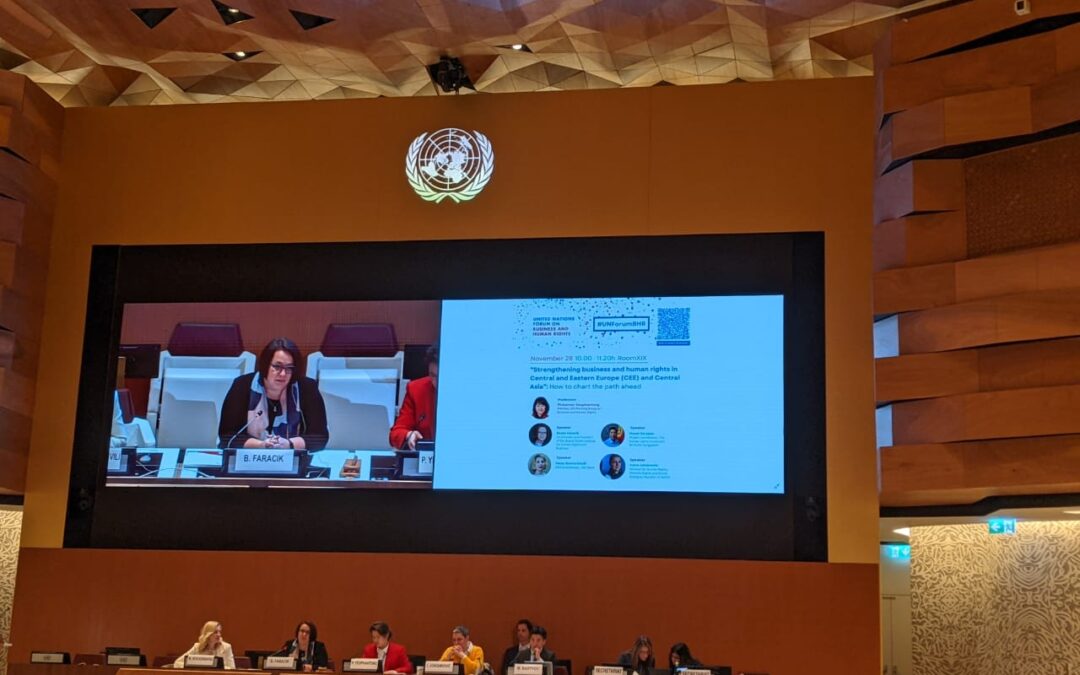
Z przyjemnością informujemy, że już po raz piąty PIHRB współorganizował sesję poświęconą wdrażaniu Wytycznych ONZ dot. biznesu i praw człowieka w Europie Środkowo-Wschodniej i Azji Centralnej. Prezeska PIHRB była także jedną z prelegentek, zabierających głos w tegorocznej sesji. Wydarzenie było organizowane przez Grupę Roboczą ONZ ds. biznesu i praw człowieka we współpracy z Polskim Instytutem Praw Człowieka i Biznesu, Uniwersytetem Prawa im. J. Mądrego w Charkowie oraz UNDP.

Nagranie z sesji jest dostępne tutaj.

Wszystkie informacje dot. sesji są dostępne na stronie ONZ oraz poniżej.

Strengthening Business and Human Rights in Central and Eastern Europe (CEE) and Central Asia: How to Chart the Path Ahead

Session co-organized by the Working Group on Business and Human Rights, the Polish Institute for Human Rights and Business (PL), Y. Mudryi National Law University (UA), and the United Nations Development Programme (UNDP) 

Interpretation provided in  English and Russian.

Brief description of the session: 
Developments in business and human rights in Central Asia, geostrategically positioned as a bridge that connects the vast Asian continent with Central and Eastern Europe, offer a valuable opportunity not only for mutual learning across Central and Eastern Europe and Central Asia regions but equally for cross-regional collaboration to tackle the pressing business-related human rights challenges faced in these two regions.

Especially in view of the recent mandatory human rights diligence developments in Europe, and specifically at the EU level, which stand to generate profound implications for States and businesses operating in Central and Eastern Europe, along with Central Asia, it is necessary for there to be an invigorated emphasis on collaborative efforts to promote and implement the UN Guiding Principles on Business and Human Rights (UNGPs). Indeed, multi-stakeholder dialogue is imperative to building a common understanding within both regions of the UNGPs. As highlighted in the UN Working Group’s recent report to the Human Rights Council on “Building Capacity for the Implementation of the United Nations Guiding Principles on Business and Human Rights”, the inclusive engagement with stakeholders — in particular, the meaningful participation of individuals and communities affected by business-related human rights abuse — is likewise central to strengthening the capacity of States, businesses, investors, academia and civil society, in order to expand the business and human rights community and achieve the critical policy and regulatory momentum for the realization of the UNGPs in these two regions.

The session brings together practitioners and experts of business and human rights to distill insights from current efforts by States, businesses, and civil society to promote and implement the UNGPs, including through multi-stakeholder initiatives and the development of guidance on the various aspects of responsible business conduct. Speakers will demonstrate the importance of putting rights holders and their voices at the center of efforts to translate the UNGPs into action as a necessary part of effective human rights due diligence legislation and processes.

Key objectives of the session:

  • Develop practical pathways for how the UNGPs as a policy and normative framework can be leveraged to bring States, businesses, and civil society together and generate sustainable and inclusive solutions to address business-related human rights challenges in Central and Eastern Europe as well as Central Asia;
  • Discuss the anticipated implications of the EU corporate sustainability due diligence directive on non-EU countries in the two regions, and what is expected from States and businesses in the region to ensure that legal developments in Western Europe result in positive outcomes for stakeholders in Central and Eastern Europe as well as Central Asia;
  • Highlight examples of emerging positive practices that have facilitated meaningful, inclusive, and effective multi-stakeholder engagement;
  • Identify the key drivers and challenges for advancing UNGPs implementation in the two regions.

Additional background documents: 

  • UN Working Group report on “Building Capacity for the Implementation of the United Nations Guiding Principles on Business and Human Rights”, available at A/HRC/53/24
  • UNDP (United Nations Development Programme) (2023). The Status of the Implementation of the UNGPs on Business and Human Rights in Europe and Central Asia. Istanbul: United Nations Development Programme. https://www.undp.org/eurasia/publications/implementation-un-guiding-principles-business-and-human-rights-ecis
  • Faracik, B., Uvarova, O. (red.) (2023). How (not) to Do Business and Human Rights in Central and Eastern Europe and Central Asia. Case Studies, PIHRB WPS 1/2023, Częstochowa: Polski Instytut Praw Człowieka i Biznesu. https://pihrb.org/wp-content/uploads/2023/06/PIHRB-WPS-1-2023-How-not-to-do-business-and-human-rights-in-CEE-CA.pdf

Moderators

avatar for Pichamon Yeophantong

Pichamon Yeophantong, Member, UN Working Group on Business and Human Rights

Ms. Pichamon Yeophantong is Associate Professor and Head of Research at the Centre for Future Defence and National Security, Deakin University. She also leads the Responsible Business Lab and the Environmental Justice and Human Rights Project, which are funded by an Australian Research… Read More →


Speakers

avatar for Ivana Joksimović

Ivana Joksimović, Minister for Human Rights, Minority Rights and Social Dialogue, Republic of Serbia

avatar for Beata Faracik

Beata Faracik, Co-Founder and President of the Board, Polish Institute for Human Rights and Business


avatar for Murat Karypov

Murat Karypov, Project coordinator, The human rights movement Bir Duino Kyrgyzstan Human rights defender, civic activist, lawyer, pro-feminist.


avatar for Maka Bochorishvili

Maka Bochorishvili, ESG Coordinator, TBC Bank

15 years experience in banking sector; since 2021, ESG Coordinator at TBC Bank – the largest financial institution in Georgia10+ years of experience in risk management, leading teams on capital and liquidity management, regulatory reporting, governance, information security