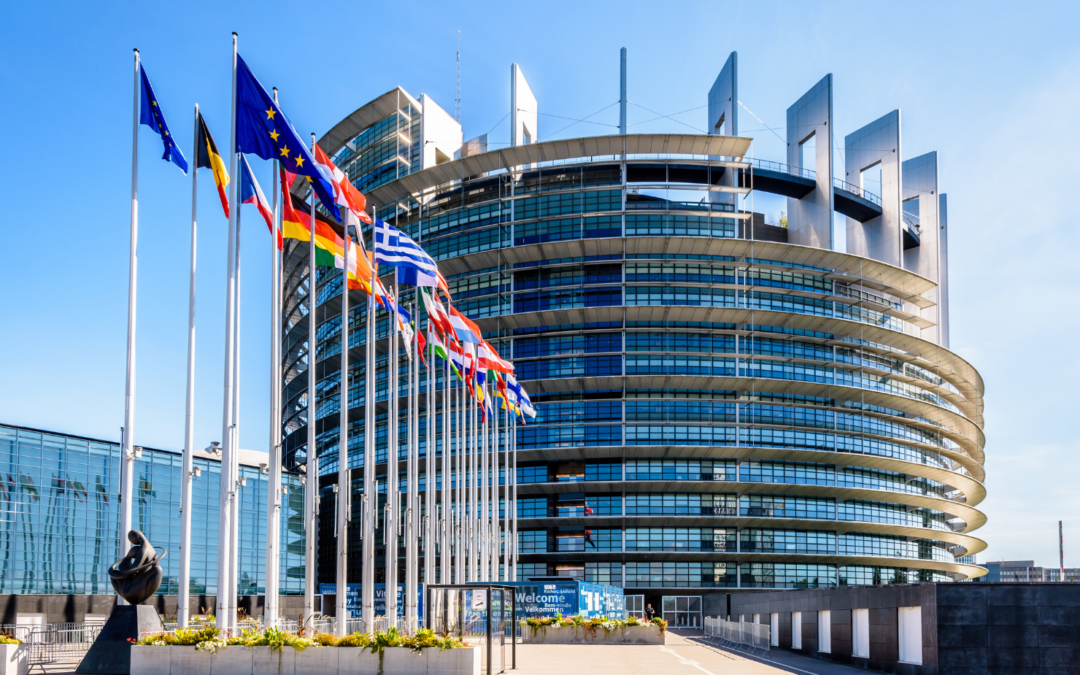
Parlament Europejski przyjął rozporządzenie o zakazie wprowadzania do obrotu w UE produktów skażonych pracą przymusową

W dniu dzisiejszym, 23 kwietnia 2024 r. Parlament Europejski zatwierdził rozporządzenie w sprawie pracy przymusowej (Forced Labour Regulation, FLR). Było to wynikiem wspólnego wysiłku, w tym publikacji i rozpowszechnienia oświadczenia znaczącego grona interesariuszy. Wśród 76 podmiotów, które wzywały decydentów do zagłosowania za przyjęciem rozporządzenia był też Polski Instytut Praw Człowieka i Biznesu. Choć to jedynie jedynie jedna z cegiełek, które przyczyniły się do pozytywnego głosowania w PE, bardzo się cieszymy, że możemy być częścią ruchu działającego na rzecz walki z pracą przymusową.

POBIERZ OŚWIADCZENIE

Następnym krokiem będzie przetłumaczenie rozporządzenia na języki państw członkowskich, a jeśli po przetłumaczeniu nie nastąpią żadne istotne zmiany w tekście, to natępnym i końcowym etapem będzie zatwierdzenie FLR w Radzie. Zamiast tego, jeśli proces tłumaczenia wymagałby zmiany brzmienia w wersji angielskiej, kolejne plenarne posiedzenie PE musiałoby je ponownie zatwierdzić.

Będziemy informować o postępach w tej sprawie ponieważ rozporządzenie to stanowi fundamentalny krok w kierunku wyeliminowania pracy przymusowej w globalnych łańcuchach dostaw.

Common rules for the common market – the CSDDD is needed for businesses and human rights

Common rules for the common market – the CSDDD is needed for businesses and human rights

Common rules for the common market – the CSDDD is needed for businesses and human rights

Authors: Michaela Streibelt, Daniel Schönfelder, Claire Bright, Stéphane Brabant, Beata Faracik, Angelica Bonfanti, Carmen Marquez Carrasco, Martijn Scheltema, Lisa Szeponik, James Sinclair, Serra Cremer Iyi, Juho Saloranta, Theresa Gigov, Noah Neitzel, Cecilia Barral Diego and Céline Graça Pires.

[Niniejszy artykuł został pierwotnie opublikowany na Nova Centre on Business, Human Rights and the Environment Blog Uniwersytetu Nova w Lizbonie – link]


The Corporate Sustainability Due Diligence Directive (CSDDD) is on the Council’s agenda for this week, which might be one of the last chances for the urgently needed directive to be adopted before the EP elections. There still seems to be a lack of understanding regarding the substantive arguments raised by some in criticism of the directive. Upon closer investigation, these arguments are based on an inaccurate understanding of the law. As professionals working with companies on how to implement human rights in their activities and supply chains, the authors of this text address them from a practical standpoint.

It is also worth remembering from the outset that, in the seminal study on due diligence through the supply chain, the vast majority of stakeholders (including notably  businesses, civil society, academics and government officials) were in favour of the introduction of mandatory due diligence at the European level in order to identify, prevent and address the adverse human rights and environmental impacts that companies can have in their operations and throughout their global value chains. It was perceived as the regulatory option which would yield the greatest positive social, environmental, and human rights impacts. Interestingly, only some of the business associations (which are now the most vocal group against the directive) were not in favour of the adoption of a mandatory due diligence law at the European level, unlike all other stakeholder groups including companies themselves and their own member companies which saw the benefits of an EU legislation on mandatory due diligence. Indeed, nearly 70% of companies surveyed anticipated that mandatory human rights and environmental due diligence legislation would benefit business by providing legal certainty and leveling the playing field by holding all competitors in the EU to the same standards.

The study also highlighted the potential of such type of regulation in improving access to remedies for affected individuals and communities and improving the implementation of due diligence practices and processes by companies. The study, which gathered over 600 responses from key stakeholders throughout the European Union highlighted the limitations of soft law and voluntary approaches in regulating corporate behaviour in relation to adverse human rights and environmental impacts, since, just over one-third of business respondents indicated that their companies undertake human rights and environmental due diligence, and in the majority of cases, the due diligence exercise was limited to first-tier suppliers.

A bureaucracy monster, harmful to companies?

Some political parties and business associations have criticised the directive and alleged it would overly burden companies, especially SMEs. It has also been wrongly argued that the directive requires companies to guarantee that there are no potential or actual adverse impacts in their supply chain. That would indeed be impossible. However, a careful analysis of the directive shows that it does in fact not set forth such requirements. On the contrary, and in line with international standards in the field which impose an obligation of means and not an obligation of result, the directive simply requires companies to put in place due diligence processes which are appropriate to their size and influence, including the possibility to prioritize the most severe risks. In other words, the directive sets out a standard of conduct, what society expects from a reasonable company behaving in a responsible and sustainable way. Nothing more, nothing less. There is no expectation for companies to be perfect, they only have to show that they are doing their best efforts to avoid harming human rights in their activities and throughout their supply chains and remedy any such harm when they do occur. Also, and in line with international standards, it embeds the proportionality principle whereby companies that have more means (i.e. larger companies) are required to do more. Furthermore, the CSDDD contains provisions that specifically protect small and medium enterprises (SMEs): they have to be treated fairly and cannot be overburdened. In practice, SMEs are already facing increasing demands from their buyers in relation to human rights and the environment (regardless of the directive), but are not afforded any support for doing so. The directive seeks to change this and SMEs would benefit from these rules.

Level playing field and uniform standard instead of patchwork legislation

The CSDDD would create a common standard for the common market of the EU. Having one uniform standard in the whole EU benefits competition. In the study on due diligence through the supply chains, 70% of the companies surveyed affirmed that having one uniform standard at the EU level rather than a patchwork of different standards at the national levels would actually benefit business.

Currently, France, Germany and Norway have due diligence laws, the Netherlands adopted the Child Labour Due Diligence Act in 2019 (even though it is not yet into force), and legislative proposals in this field have emerged in many more countries. Other member states are likely to pass such laws should the CSDDD fail. The CSDDD is a chance to ensure efficiency and coherence.

The CSDDD ensures that European companies are not put at a competitive disadvantage compared to their non European counterparts by also requiring non-EU companies with a certain turnover in the EU or royalties from franchise or licensing agreements to put in place human rights and environmental due diligence processes. European companies who compete with companies from abroad would benefit from such a level playing field.

Withdrawal from difficult regions?

The CSDDD does not require European companies to withdraw from difficult at risk countries, regions, supply chains or suppliers. Instead, in line with international standards, the directive provides that termination should be used only as a matter of last resort and guarantee a responsible exit. The examples of France and Germany have shown that the fear that suppliers from countries of the Global South will refuse to provide to European companies is completely unfounded. In fact, many of these suppliers are already in the process of developing due diligence processes to respond to the existing requirements of their buyers who are exercising due diligence throughout their supply chains to respond to consumers and investors pressure. Due diligence will not offset the competitive advantage of lower production costs and many resources simply are not available in the EU (coffee, cocoa, cobalt to just name a few).

Clear rules on civil liability create legal security

Among the most misleading claims in relation to the CSDDD is that companies will face unmanageable and unreasonable liability risks. In fact, it is quite the opposite since exercising appropriate human rights and environmental due diligence is actually the best way for companies to protect themselves from liability. As a result, by setting out requirements and clear expectations for companies in relation to due diligence, the CSDDD helps them address the liability risk.

In fact, however, the liability rule of the CSDDD is beneficial to companies since it would create a clear, balanced, uniform, and – most importantly – almost universally applicable liability standard. Currently, companies already face liability risks as exemplified by the recent cases against Shell in the Netherlands, and La Poste in France, amongst many others.

They might be liable under different national laws because the law applicable to a tortious act is (at least in most cases) the law where the damage occurred. This means that European companies have to consider potential liability risks under many different domestic laws, which might require understanding liability norms of other countries in other languages and even getting legal advice in different countries. The CSDDD only holds companies liable for damages resulting from the intentions or negligent violation of the obligation to implement preventive or remedial measures.  If they conducted appropriate due diligence, they are exonerated, making liability manageable and foreseeable. This norm would be applicable as an overriding mandatory provision leading to the exclusion of other liability norms. Therefore, the CSDDD provides clear and fair rules on civil liability that create legal security for companies and victims.

Corporate sustainability with or without the CSDDD

Whether or not the CSDDD is adopted, companies are already and will increasingly be subjected to expectations and requirements to put in place due diligence processes to ensure that they do not harm human rights and the environment in their operations and throughout their supply chains. Indeed, international standards like the UN Guiding Principles on Business and Human Rights, the OECD Guidelines for Multinational Enterprises and related guidance, and the ILO Tripartite Declaration of Principles concerning multinational enterprises and social policy already exist and are being implemented by a growing number of companies. They are also influencing States to adopt laws in this respect. In addition, companies are increasingly subjected to the pressure from consumers and investors to behave responsibly and sustainably. Recent studies estimate that 160 millions children are in child labour (that is one child out of 10 on the global scale), a number which has been increasing in recent years, especially amongst children between 5 and 11 years old working in hazardous conditions. The ILO estimates that 18 million people are exploited as forced labour in the private sector. Other studies have consistently shown that companies can be involved in adverse human rights impacts covering the whole spectrum of internationally recognised human rights. Preventing and addressing such involvement through policies and practices is core to sustainable development as recognised by the UN Sustainable Development Goals which affirm that human rights are at the core of all 17 goals and 169 targets. At the end of the day, the CSDDD simply turns already existing international standards and societal expectations on corporate behaviour into hard law in order to ensure companies are on the right side of history.

Suggested Citation: M. Streibelt, D. Schönfelder, C. Bright and al., ‘Common rules for the common market – the CSDDD is needed for businesses and human rights’, Nova Centre on Business, Human Rights and the Environment Blog, 27th Feburary 2024, link: https://novabhre.novalaw.unl.pt/common-rules-for-the-common-market-the-csddd-is-needed-for-businesses-and-human-rights/

Osiągnięto porozumienie w sprawie dyrektywy CSDD: Kluczowy krok, ale utracona szansa na przyjęcie daleko idących zmian

Osiągnięto porozumienie w sprawie dyrektywy CSDD: Kluczowy krok, ale utracona szansa na przyjęcie daleko idących zmian


Bruksela, 14 grudnia 2023 r. – European Coalition for Corporate Justice (ECCJ) z zadowoleniem przyjmuje  porozumienie polityczne dotyczące Dyrektywy w sprawie należytej staranności przedsiębiorstw w zakresie zrównoważonego rozwoju (CSDDD, CS3D), mimo, iż nie wykorzystano wszystkich możliwości, jakie dawał proces negocjacyjny. To ważny krok w ustanowieniu wymogów i oczekiwań wobec korporacji w zakresie poszanowania praw człowieka i środowiska. Nie wystarczający jednak, aby położyć kres bezkarności korporacji.

Unijne przepisy dotyczące należytej staranności są ważnym krokiem naprzód, ale to nie koniec  walki z bezkarnością korporacji.

W czwartek rano ustawodawcy UE osiągnęli porozumienie polityczne w sprawie najbardziej kontrowersyjnych kwestii dotyczących standardów postępowania w biznesie, które mają zostać ustanowione przez Dyrektywę CSDD.  Zgodnie z przepisami, duże i międzynarodowe korporacje tzw. wysokiego ryzyka będą musiały zająć się zagrożeniami jakie ich działalność i relacje biznesowe niosą dla praw człowieka, społeczności lokalnych i środowiska naturalnego. Co więcej, poszkodowani będą mogli pociągnąć firmy do odpowiedzialności przed sądami UE, jeśli ucierpią   w wyniku ich działalności. .

Od ponad dekady sieć organizacji pozarządowych ECCJ apeluje o wiążące przepisy UE wdrażające międzynarodowe standardy praw człowieka, które wymagałyby od przedsiębiorstw wzięcia pod uwagę zagrożeń dla praw człowieka i środowiska naturalnego w ich łańcuchach wartości. ECCJ z zadowoleniem przyjmuje dzisiejsze porozumienie w sprawie włączenia bardzo potrzebnych środków dostępu do wymiaru sprawiedliwości dla ofiar nadużyć ze strony przedsiębiorstw, a w szczególności umożliwienia zwiększonego dostępu do dowodów i rozsądnych terminów składania roszczeń.

Jednakże wysiłki państw UE i lobby branżowego, które zmierzały do osłabienia tej dyrektywy, sprawiły, że szansa na wprowadzenie transformujących zmian w sposobie działania międzynarodowych korporacji została utracona. Niepokojące jest to, że sektor usług finansowych został zwolniony z przeprowadzania należytej staranności wobec swoich klientów. Chociaż firmy, w tym niektóre podmioty finansowe, będą zobowiązane do przyjęcia i wdrożenia planów transformacji klimatycznej, to niepokoi fakt, że odpowiedzialność klimatyczna jest niewystarczająca i została wyłączona z zakresu odpowiedzialności cywilnej,

Nele Meyer, Dyrektorka ECCJ:

„Porozumienie w sprawie wiążących standardów UE jest wprawdzie kamieniem milowym, ale walka z bezkarnością przedsiębiorstw jeszcze się nie zakończyła. Za przełomowe można uznać to, że firmy będą miały obowiązek przestrzegania regulacji, zapewniając tym samym, że zysk nie będzie ważniejszy od praw człowieka lub środowiska. Ofiarom nadużyć korporacyjnych łatwiej będzie dochodzić sprawiedliwości, co już jest zwycięstwem w dzisiejszym porozumieniu”.

„Poprzez rezygnację z odpowiedzialności klimatycznej w zapisach dyrektywy, państwa UE przymykają oko na globalną katastrofę klimatyczną. Trudno się też pogodzić z tym, że potężne podmioty finansowe zostały wykluczone, mimo że odgrywają rolę motorów działalności gospodarczej i są kluczowymi facylitatorami zielonej transformacji EU.

Co dalej z dyrektywą?

Osiągnięto porozumienie między Parlamentem Europejskim, z wiodącą rolą Lary Wolters, jako posłanki sprawozdawczyni,  Radą UE, koordynowaną przez hiszpańską Prezydencję, oraz Komisją Europejską. Mimo tego porozumienia, prace nad ostatecznym tekstem Dyrektywy CSDD pozostają w toku. Konieczne są spotkania techniczne, których rolą jest dopracowanie osiągniętego porozumienia politycznego i upewnienie się, że wczorajsze rozmowy trójstronne  nie pozostawiły żadnych luk. Następnie Rada UE, w trakcie nadchodzącej Prezydencji belgijskiej oraz Parlament Europejski będą głosować nad zatwierdzeniem ostatecznego tekstu, torując drogę do wdrożenia dyrektywy na szczeblach krajowych. ECCJ oczekuje, że ostateczny tekst powinien zostać poddany pod głosowanie około marca 2024 roku.

Ostatnim krokiem jest możliwość pociągnięcia firm, w tym sektora finansowego, do odpowiedzialności za ich wpływ na zmiany klimatyczne.

Więcej informacji: 

Beata Faracik,  President of the Board, PIHRB – beata.faracik@pihrb.org
Małgorzata Szlendak, Communication Coordinator, PIHRB – malgorzata.szlendak@pihrb.org
Sabela Gonzalez Garcia, ECCJ Communications Manager sabela.gonzalez.garcia@corporatejustice.org

Oryginalny tekst informacji prasowej w j. angielskim.

12. Forum ONZ dot. biznesu i praw człowieka – PIHRB współorganizatorem sesji poświęconej EŚW i Azji Centralnej

12. Forum ONZ dot. biznesu i praw człowieka – PIHRB współorganizatorem sesji poświęconej EŚW i Azji Centralnej

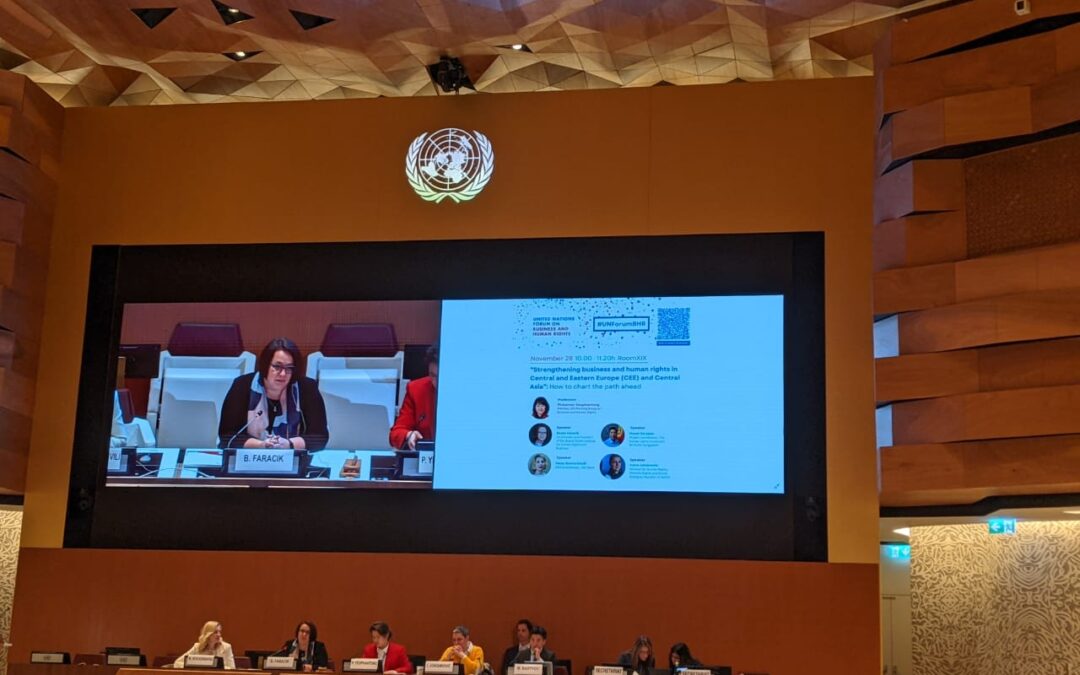
Z przyjemnością informujemy, że już po raz piąty PIHRB współorganizował sesję poświęconą wdrażaniu Wytycznych ONZ dot. biznesu i praw człowieka w Europie Środkowo-Wschodniej i Azji Centralnej. Prezeska PIHRB była także jedną z prelegentek, zabierających głos w tegorocznej sesji. Wydarzenie było organizowane przez Grupę Roboczą ONZ ds. biznesu i praw człowieka we współpracy z Polskim Instytutem Praw Człowieka i Biznesu, Uniwersytetem Prawa im. J. Mądrego w Charkowie oraz UNDP.

Nagranie z sesji jest dostępne tutaj.

Wszystkie informacje dot. sesji są dostępne na stronie ONZ oraz poniżej.

Strengthening Business and Human Rights in Central and Eastern Europe (CEE) and Central Asia: How to Chart the Path Ahead

Session co-organized by the Working Group on Business and Human Rights, the Polish Institute for Human Rights and Business (PL), Y. Mudryi National Law University (UA), and the United Nations Development Programme (UNDP) 

Interpretation provided in  English and Russian.

Brief description of the session: 
Developments in business and human rights in Central Asia, geostrategically positioned as a bridge that connects the vast Asian continent with Central and Eastern Europe, offer a valuable opportunity not only for mutual learning across Central and Eastern Europe and Central Asia regions but equally for cross-regional collaboration to tackle the pressing business-related human rights challenges faced in these two regions.

Especially in view of the recent mandatory human rights diligence developments in Europe, and specifically at the EU level, which stand to generate profound implications for States and businesses operating in Central and Eastern Europe, along with Central Asia, it is necessary for there to be an invigorated emphasis on collaborative efforts to promote and implement the UN Guiding Principles on Business and Human Rights (UNGPs). Indeed, multi-stakeholder dialogue is imperative to building a common understanding within both regions of the UNGPs. As highlighted in the UN Working Group’s recent report to the Human Rights Council on “Building Capacity for the Implementation of the United Nations Guiding Principles on Business and Human Rights”, the inclusive engagement with stakeholders — in particular, the meaningful participation of individuals and communities affected by business-related human rights abuse — is likewise central to strengthening the capacity of States, businesses, investors, academia and civil society, in order to expand the business and human rights community and achieve the critical policy and regulatory momentum for the realization of the UNGPs in these two regions.

The session brings together practitioners and experts of business and human rights to distill insights from current efforts by States, businesses, and civil society to promote and implement the UNGPs, including through multi-stakeholder initiatives and the development of guidance on the various aspects of responsible business conduct. Speakers will demonstrate the importance of putting rights holders and their voices at the center of efforts to translate the UNGPs into action as a necessary part of effective human rights due diligence legislation and processes.

Key objectives of the session:

  • Develop practical pathways for how the UNGPs as a policy and normative framework can be leveraged to bring States, businesses, and civil society together and generate sustainable and inclusive solutions to address business-related human rights challenges in Central and Eastern Europe as well as Central Asia;
  • Discuss the anticipated implications of the EU corporate sustainability due diligence directive on non-EU countries in the two regions, and what is expected from States and businesses in the region to ensure that legal developments in Western Europe result in positive outcomes for stakeholders in Central and Eastern Europe as well as Central Asia;
  • Highlight examples of emerging positive practices that have facilitated meaningful, inclusive, and effective multi-stakeholder engagement;
  • Identify the key drivers and challenges for advancing UNGPs implementation in the two regions.

Additional background documents: 

  • UN Working Group report on “Building Capacity for the Implementation of the United Nations Guiding Principles on Business and Human Rights”, available at A/HRC/53/24
  • UNDP (United Nations Development Programme) (2023). The Status of the Implementation of the UNGPs on Business and Human Rights in Europe and Central Asia. Istanbul: United Nations Development Programme. https://www.undp.org/eurasia/publications/implementation-un-guiding-principles-business-and-human-rights-ecis
  • Faracik, B., Uvarova, O. (red.) (2023). How (not) to Do Business and Human Rights in Central and Eastern Europe and Central Asia. Case Studies, PIHRB WPS 1/2023, Częstochowa: Polski Instytut Praw Człowieka i Biznesu. https://pihrb.org/wp-content/uploads/2023/06/PIHRB-WPS-1-2023-How-not-to-do-business-and-human-rights-in-CEE-CA.pdf

Moderators

avatar for Pichamon Yeophantong

Pichamon Yeophantong, Member, UN Working Group on Business and Human Rights

Ms. Pichamon Yeophantong is Associate Professor and Head of Research at the Centre for Future Defence and National Security, Deakin University. She also leads the Responsible Business Lab and the Environmental Justice and Human Rights Project, which are funded by an Australian Research… Read More →


Speakers

avatar for Ivana Joksimović

Ivana Joksimović, Minister for Human Rights, Minority Rights and Social Dialogue, Republic of Serbia

avatar for Beata Faracik

Beata Faracik, Co-Founder and President of the Board, Polish Institute for Human Rights and Business


avatar for Murat Karypov

Murat Karypov, Project coordinator, The human rights movement Bir Duino Kyrgyzstan Human rights defender, civic activist, lawyer, pro-feminist.


avatar for Maka Bochorishvili

Maka Bochorishvili, ESG Coordinator, TBC Bank

15 years experience in banking sector; since 2021, ESG Coordinator at TBC Bank – the largest financial institution in Georgia10+ years of experience in risk management, leading teams on capital and liquidity management, regulatory reporting, governance, information security
Szacunek i ochrona w białych rękawiczkach. Konferencja prasowa

Szacunek i ochrona w białych rękawiczkach. Konferencja prasowa

24 października 2023 r. w Domu Innowacji Społecznych „Marzyciele i Rzemieślnicy” w Warszawie odbyła się konferencja prasowa Polskiego Instytutu Praw Człowieka i Biznesu pt.: „Biznes i prawa człowieka. Ochrona i szacunek w białych rękawiczkach”. 

Beata Faracik, LL.M., Współzałożycielka & Prezeska Zarządu PIHRB oraz Bartosz Kwiatkowski, Wiceprezes Zarządu PIHRB i Dyrektor Fundacji Frank Bold Polska przedstawili na niej:

  • naszą ocenę stanu przestrzegania praw człowieka w kontekście biznesu w Polsce i na świecie
  • aktualny kontekst społeczny i legislacyjny (ze szczególnym uwzględnieniem CSDDD) wraz z jego konsekwencjami dla globalnych łańcuchów dostaw
    oraz
  • nasze postulaty do polskiego rządu i biznesu.

Polski Instytut Praw Człowieka i Biznesu (PIHRB) wraz z innymi organizacjami pozarządowymi uważnie śledzi problematykę poszanowania praw człowieka w codziennej działalności biznesu (Business & Human Rights, BHR) i z niepokojem zauważa, że ginie ona w morzu ogólnych deklaracji, tymczasowych lub wręcz fasadowych rozwiązań i ciągnących się latami negocjacji legislacyjnych. Dobre przykłady biznesowe są wyjątkiem a firmy i tak zwykle pytają: „czy rzeczywiście MUSIMY to robić”? Zysk lub jego brak często dosłownie przesądzają o ludzkich losach. Bierność państwa i brak rozwiązań systemowych stanowiących zachętę do prowadzenia biznesu w sposób odpowiedzialny i poszanowaniem praw ludzi i dbałością o planetę pogłębiają ten problem. A nasza globalna wioska nie jest już w stanie dłużej znosić nierówności i – nawet jeśli nie chcemy patrzeć – nie radzi sobie z kryzysem klimatycznym i migracyjnym, z wyzyskiem ludzi, w tym dzieci.

Wybory parlamentarne w naszym kraju i perspektywa utworzenia nowego rządu oraz ostatnia faza prac nad europejską Dyrektywą w sprawie należytej staranności przedsiębiorstw w zakresie zrównoważonego rozwoju (ang.: Corporate Sustainability Due Diligence Directive, CSDDD)to dobry moment by ten temat nagłośnić.
Pełny tekst informacji prasowej można pobrać poniżej:

Czy 1 czerwca 2023 zapisze się w historii praw człowieka i biznesu

Czy 1 czerwca 2023 zapisze się w historii praw człowieka i biznesu

Edukacja, prawo zapobiegające nadużyciom i dające dostęp do wymiaru sprawiedliwości oraz należyta staranność w prowadzeniu działalności biznesowej. Okazuje się, że w XXI w. wciąż mamy z tym problem. System, który powinien wspierać, ciągle kuleje. 1 czerwca 2023 jest szansa na rehabilitację. Parlament Europejski będzie głosował za kompromisowym projektem Dyrektywy w sprawie należytej staranności przedsiębiorstw w zakresie zrównoważonego rozwoju (CSDDD). Ratunkiem dla progresywnych rozwiązań jest wyłącznie głos na „TAK”.

Tego samego dnia rozpoczyna się w Warszawie 1 Międzynarodowa Konferencja Praw Człowieka i Biznesu w Europie Środkowo-Wschodniej i Azji Centralnej organizowana przez Polski Instytut Praw Człowieka i Biznesu (PIHRB) oraz Narodowy Uniwersytet Prawa im. Jarosława Mądrego (YMNLU) w Charkowie. W dobie globalizacji rozmowa o europejskich sprawach wyłącznie
w europejskim gronie byłaby krótkowzroczna; bo przecież łańcuchy wartości wielkich koncernów sięgają daleko poza granice Unii Europejskiej (UE) a dla praw człowieka granice
w ogóle nie istnieją. Zwiększanie sieci osób, które o te prawa będą walczyć wydaje się być koniecznością.
Zobacz pełen tekst informacji prasowej.